
Vintage Repair & Service
If you have a vintage British or European automobile that needs repairs, Import Specialties will schedule time to inspect the vehicle, so that we can give you an estimate of the needed Vintage repairs and services. The inspection includes the engine and all components: Transmission, clutch, carburetors, fuel delivery systems, filters, hoses belts, exhaust, complete braking system, suspension-shocks and struts, power steering systems windows and doors, electrical including wiring, battery, starter, alternator gauges, instrument cluster, power windows, operations of convertible tops, wiper motors & more.

We inspect all visible engine parts – block, crankcase, head, transmission housing, etc. – for leaks, cracks or other damage. We can do a compression test on each cylinder to assess the condition of the engine.
If internal engine problems are found, we can inspect all moving parts including the valve train, pistons, crankshaft, camshaft, oil pump, bearings and bushings, flywheel, water pump and other internal engine components. Internal engine parts will be machined or re-manufactured to bring them within specifications. If problems are suspected with the transmission, clutch, differential and all other moving parts of the drivetrain, we will disassemble as necessary to inspect and repair these components.
How long does vintage repair take?
Vintage Mechanical Repair can take weeks or even months to complete. Parts often must be remanufactured. Some parts take weeks to obtain. Once all the vintage repairs are completed, we will fine-tune the engine and test drive repeatedly until we are satisfied the vehicle is ready to deliver to you, the customer. Vehicle mechanical repair can be performed at the discretion, desire, or taste of a vehicle owner or restorer. We strive to ensure our end product matches your vision. We want happy cars and happy customers.

Read about how we restored a 1970 Jaguar E-Type
Reviving a Classic: Restoring a 1935 Alvis Speed 20

For nearly a century, the 1935 Alvis Speed 20 has been a shining example of automotive elegance and performance. Recently, this timeless beauty spent two months in our shop, undergoing meticulous repairs and maintenance to ensure it continues turning heads on the road.
One of the major issues we tackled was a battery drain caused by a faulty voltage regulator. After replacing the regulator, the Alvis regained its electrical efficiency. Additionally, we discovered deteriorated engine intake gaskets, leading to leaks. By installing fresh gaskets, we restored the engine’s integrity and performance.
The parking brake rod had suffered damage, with a noticeable bend affecting its functionality. A careful repair brought it back to proper working order. Another unique challenge was the failed right-side trafficator—an obsolete type of turn signal used in mid-20th-century vehicles. Unlike modern indicators, these retractable arms or semaphores illuminated to signal turns, often positioned at the door pillar. We sourced parts and used bit and pieces to fabricate a trafficator, preserving the car’s classic character. (See photo of the trafficator)

Cooling issues were also addressed by rebuilding a leaking water pump, ensuring efficient temperature regulation for the engine. Additionally, we diagnosed a vacuum leak in the choke, which was causing backfiring. A precise repair eliminated this issue, restoring smooth operation.
Due to coolant leaking from the head, we removed the valve cover, retorqued the head bolts, and topped off the oil. These final touches brought the Alvis back to optimal condition, ready to cruise once again in all its 90-year-old glory.

With each careful repair, this historic masterpiece remains a testament to fine craftsmanship and enduring automotive excellence. Now, fully rejuvenated, the Alvis Speed 20 continues to command attention wherever it goes—a true celebration of automotive history.

1937 MG-TA — A Journey Back to the Open Road
When the 1937 MG-TA first arrived in our workshop, it carried the quiet dignity of a car that had lived a long life — and the unmistakable signs of decades spent at rest. Dust softened its elegant lines, its mechanical voice was silent, and its once-eager stance had settled into stillness. Yet beneath the wear was a promise: that with care, skill, and respect for its heritage, this TA could once again take to the road with the same poise and charm it possessed in 1937. This Vintage Mechanical Repair would not be about erasing its past, but about preparing it for the miles — and memories — still ahead.

Initial Assessment
The project began with a full inspection of the steering, suspension, brakes, exhaust, cooling, and electrical systems. Every belt, hose, and fluid were checked, the battery and charging system tested, and the car was road-tested to establish a baseline. This revealed a vehicle in need of comprehensive mechanical renewal — the perfect foundation for a sympathetic mechanical repair.
Front Suspension & Brake Overhaul
The front suspension was stripped to bare components. New leaf springs, trunnion bearings, spring pins, bump stops, and boots were fitted, along with a complete front axle fastener set. The braking system at the front received new wheel cylinders, brake shoes, return springs, hoses, and a full brake line set with correct adapters. All four drums were machined, with one front drum replaced. Driveshaft U-joints were renewed to eliminate play, restoring smooth power delivery.
Rear Suspension & Brake Overhaul
The rear suspension was rebuilt with new bushings, shock link studs, axle pads, and trunnion bearings. A rear axle kit with bearings was installed, along with fresh hub gaskets and axle housing hardware. The rear brakes were renewed with new wheel cylinders, springs, hoses, and a replacement drum. Handbrake cables were replaced to restore crisp mechanical operation.
Brake Master Cylinder Replacement
A new master cylinder was installed, along with fresh washers and copper plug gaskets. The system was filled with the correct DOT-spec fluid and bled to ensure firm, consistent pedal feel.
Engine Removal & Refit
The engine was removed to allow for a complete rebuild. During removal, new engine, and gearbox mounts, rebound rubbers, and radiator mounts were fitted. Electrical ignition components — distributor cap, coil, ignition wires, and spark plugs — were replaced. New battery and starter cables were installed, and pedal bushings renewed. The drivetrain was upgraded with a carefully integrated MG-TD unit, with driveshaft modifications machined for a perfect fit.


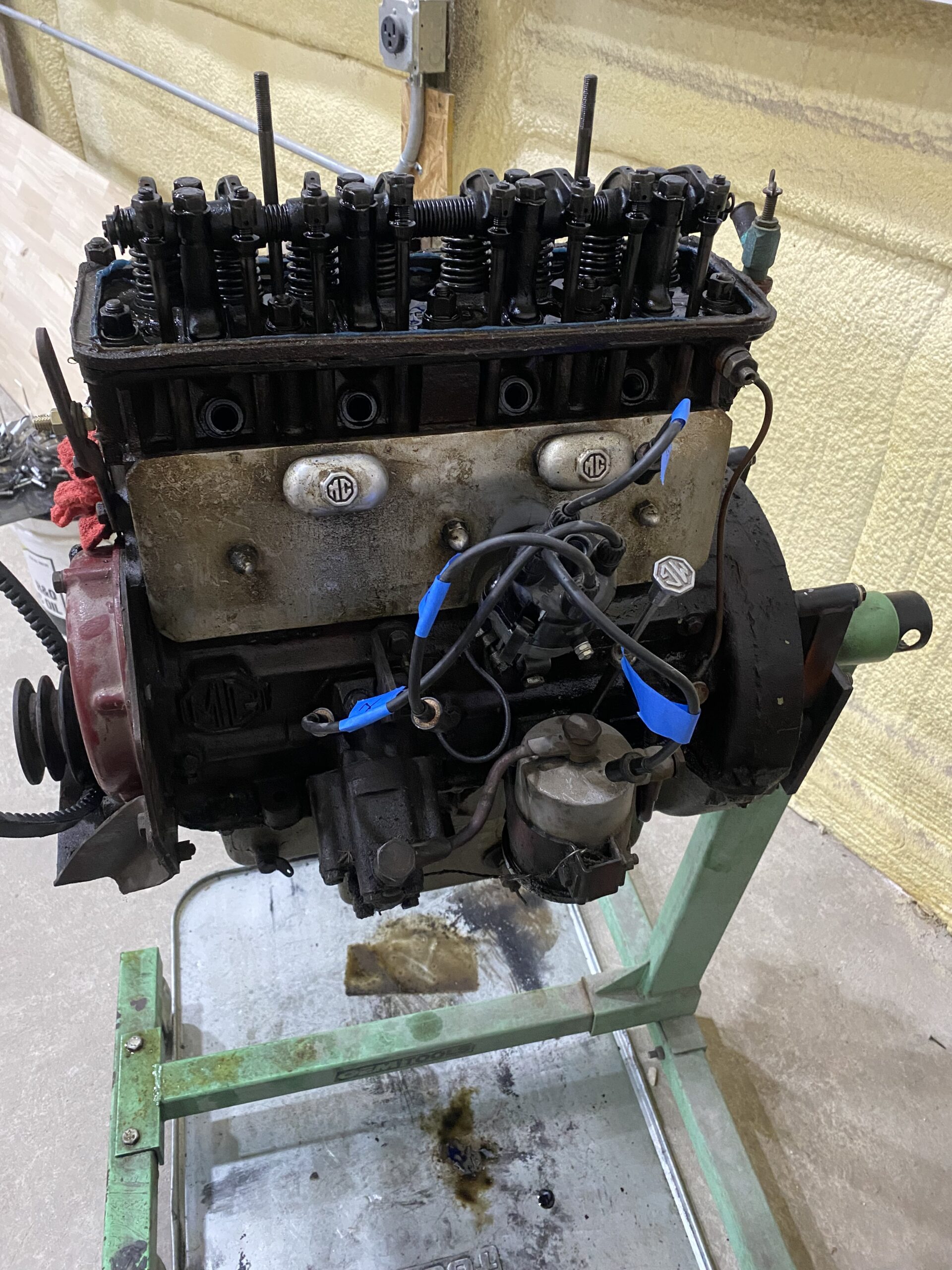
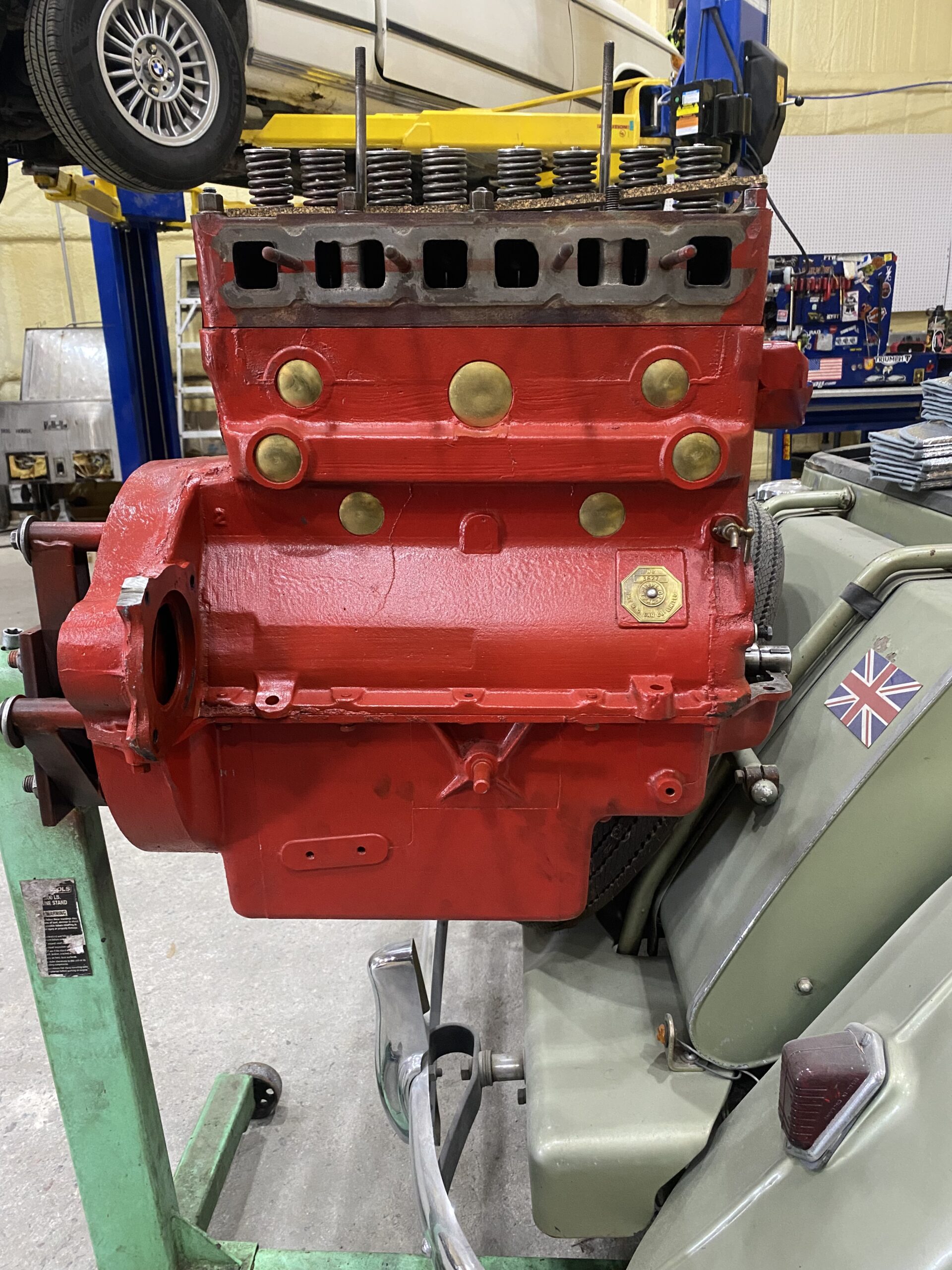
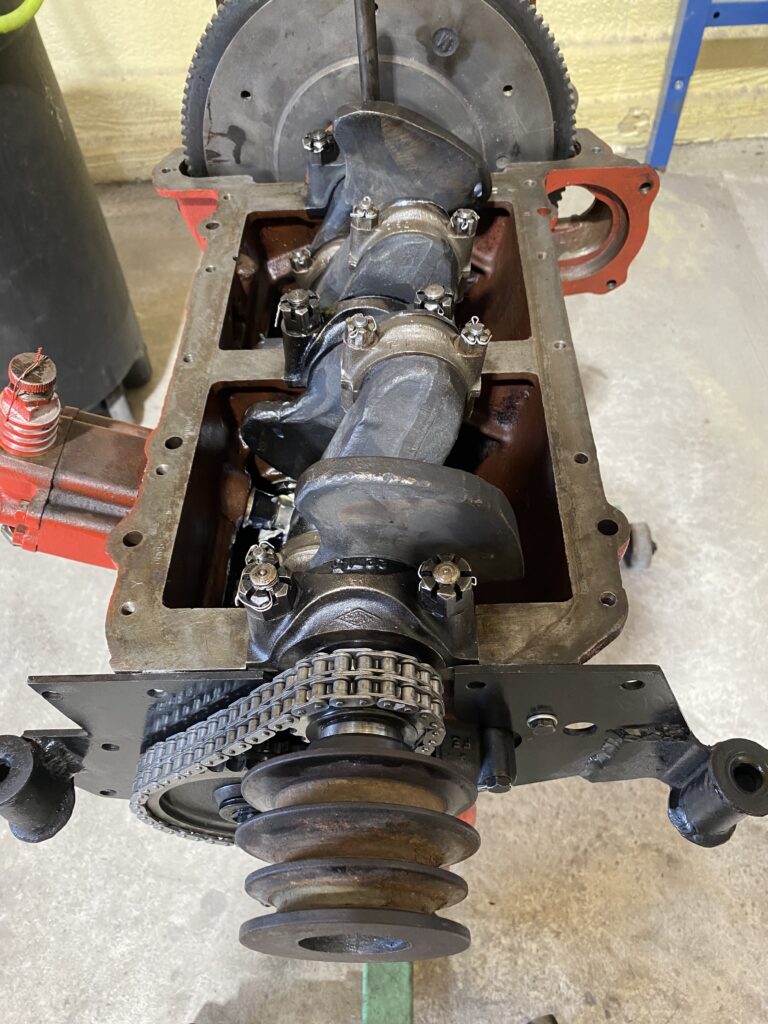

Engine Rebuild
The engine was stripped and rebuilt with new pistons (+.060), main bearings, oil pump gears, timing chain, core plugs, gaskets, crankshaft seals, and a clutch disc. The cylinder head and block were machined, and the engine refinished in gloss red. This work restored smooth, reliable power while maintaining the TA’s period character.

Carburetors Rebuild
Both carburetors were removed, rebuilt with new kits, and refitted with spacer blocks. Machining work ensured proper sealing and alignment, restoring crisp throttle response and smooth fueling.
Steering Wheel Replacement
A new steering wheel with hub was fitted, restoring both the tactile connection to the road and the period-correct look in the cockpit.
Tire Replacement
All four tires were replaced with Coker Excelsior 4.50×19 units, paired with new tubes and rim strips. The tires were mounted and balanced, ensuring safe, predictable handling.
Conclusion
From the day it was rolled into the workshop — tired, silent, and carrying the patina of decades — the 1937 MG-TA has been on a journey of renewal. Every task, from the meticulous suspension rebuild to the complete brake system overhaul, the sympathetic integration of its MG-TD drivetrain, and the precision engine and carburetor work, was guided by a single principle: preserve the car’s pre-war spirit while ensuring it can be driven and enjoyed today.
Now, with its chassis taut, its brakes firm and progressive, and its engine eager once more, the TA stands ready for the road. It is no longer a static piece of history, but a living example of it — a car that invites you to slip behind the wheel, feel the lightness of its steering, and listen to the crisp exhaust note as it winds through the gears.
Its next chapter will not be written in the quiet of a garage, but on winding lanes, at club gatherings, and in the shared smiles of those who recognize a well-driven MG. This mechanical repair is not the end of the story, but the beginning of another — one that will carry the TA’s legacy forward, mile after memorable mile.
Schedule an Appointment
Use the button below to set up an appointment to bring in your vehicle.
